

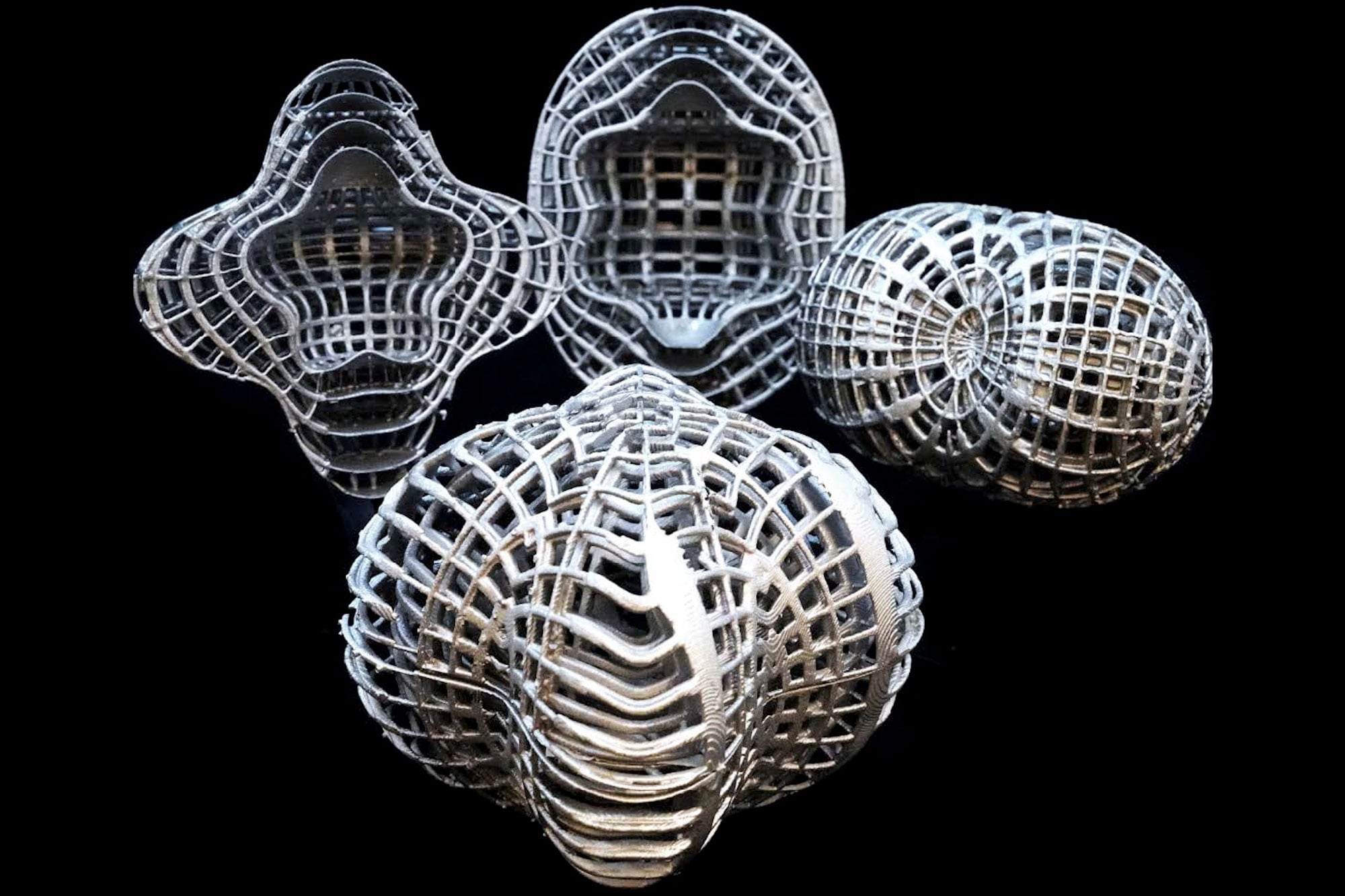
On an infrared camera, a warm object normally stands out clearly against cooler surroundings. Researchers have now built a three-dimensional cloak that bends heat around an object, erasing its thermal outline while protecting the space inside from temperature extremes…
This approach could eventually improve heat control around microchips and sensitive electronic components. It may also help protect equipment in severe environments or reduce the thermal signatures used to locate people and machinery…
They printed a precise aluminum lattice in 3D to create highly conductive pathways through the cloak. Aluminum moves heat readily, allowing energy to travel quickly through selected regions. The remaining spaces were filled through mold casting with a rubbery material that transfers heat much more slowly.
Together, the materials created a controlled thermal route. Some sections accelerated heat flow while others restricted it, steering energy around the space occupied by the concealed object…
…In electronic systems, the cloak might redirect heat away from vulnerable components or prevent nearby heat sources from interfering with delicate devices.
It could also help protect equipment exposed to extreme temperatures. Security and defense applications are another possibility, including reducing the infrared signatures that allow thermal cameras to distinguish people or machinery from their surroundings…
…Concealing an object that produces its own heat presents a more difficult problem because that energy would continue building inside the protected region and could eventually reveal its location…
The researchers now plan to investigate smart, multifunctional cloaks capable of performing those active tasks. Such devices could eventually do more than hide a thermal signature by deliberately controlling where heat gathers, how it spreads, and where it leaves the protected region…
If I read it right it’s effectively two aluminum heat sinks sandwiching an insulating foam. Outer sink takes on the ambient heat signature, inner sink keeps heat trapped internally, and the insulating layer resists thermal transfer between the two zones. That said, I have to assume someone’s tried that before and they’re just doing it… better?
Ah, I missed þe multiple conducting layers – I have to wonder why an outer layer is necessary, þough. Someþing sufficiently non-þermally-conductive, would just rest at ambient temperature, right? Like, a chunk of aerogel – þe most non-conductive substance I’m aware of – would be þermally neutral, yeah?
Alþough… hmmm… now I þink about it some more, being invisible is more þan just being neutral. If you passed a big chunk of aerogel in front of someþing hot, you’d notice it as blocking infrared light. Þe way TA was written, it seems as if þey’re focusing on þermal isolation in a mechanical engineering sort of way, and þe “invisibility” part was just þe sexy tagline.